
Default Judgment Divorce: What You Need to Know

TL;DR:
A default judgment divorce occurs when one spouse files for divorce and the other does not respond within the legal response period, resulting in a court-issued decree based on the petitioner’s requests. This process has the same legal weight as contested divorces, and respondents may lose rights to contest property, debts, or support if they do not respond timely. Proper procedural steps, including serving papers and providing financial documentation, are essential to avoid delays or invalidation of the default judgment.
A default judgment divorce is defined as a court-granted divorce where one spouse files a petition and the other spouse fails to respond within the legally required deadline. The court proceeds without the non-responding spouse’s input, issuing a binding divorce decree based on the petitioner’s requests and applicable state law. This process, formally called a default divorce judgment, is not a loophole or a shortcut. It carries the same legal weight as any contested divorce, and both petitioners and respondents face real consequences if they misunderstand how it works.
What is default judgment Divorce and how does it work?
A default judgment divorce begins the moment a petitioner properly serves their spouse with divorce papers. From that point, the clock starts. Response deadlines vary by state, typically ranging from 20 to 30 days, with states like North Dakota requiring a response within 21 days as of 2025. If the respondent does not file a written answer before that deadline expires, the petitioner can move forward without them.

The court does not simply rubber-stamp whatever the petitioner requests. A judge reviews the petition to confirm it complies with state law on property division, spousal support, and custody. The petitioner still has to show up, present documentation, and make their case. The difference is that no one is arguing the other side.
This process is distinct from an uncontested divorce, where both spouses agree on terms and file jointly. A default divorce happens because one party does not participate at all, not because both parties reached an agreement.
How do you get a default judgment Divorce?
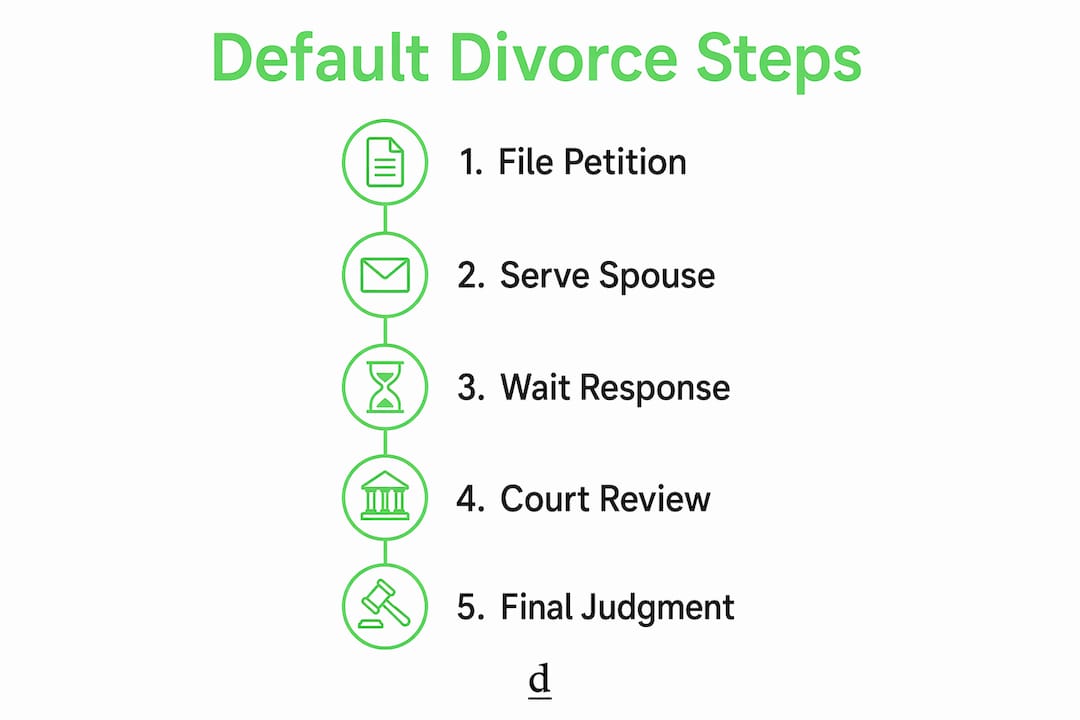
The steps to file for a default divorce follow a specific legal sequence. Skipping or mishandling any step can delay or void the entire process.
File the divorce petition. Submit your petition for dissolution of marriage with the appropriate court in your state or county.
Serve your spouse. Deliver the divorce papers to your spouse through a legally recognized method, such as a process server, sheriff, or certified mail where permitted.
File proof of service. Submit documentation to the court confirming your spouse was properly served. This is the step where most petitioners run into trouble.
Wait for the response deadline. Allow the full statutory period to expire. Deadlines commonly run 20–30 days from the date of service.
File a request for entry of default. Once the deadline passes without a response, formally ask the court to enter a default against your spouse.
Attend a court hearing. Many states require a hearing where you present financial records, including pay stubs and property lists. Hearings can run four or more hours, and jurisdictions like Maricopa County in Arizona require petitioners to complete additional checklists before the court will schedule one.
Receive the default judgment. The judge reviews your submissions, applies state law, and issues the final divorce decree.
Pro Tip: Gather your required divorce documents before you file the petition. Courts commonly ask for tax returns, bank statements, property valuations, and pay stubs at the hearing. Showing up unprepared can push your case back by weeks.
State-specific rules matter enormously here. Reviewing your state’s procedural checklist before you begin saves time and prevents costly errors.
What are the legal consequences of a default Divorce judgment?
The legal implications of a default divorce judgment fall hard on the respondent. By choosing not to participate, a respondent forfeits their right to contest division of assets, debts, or support. That is not a technicality. It means the court may divide property, assign debt, and set support amounts entirely based on the petitioner’s account of the marriage.
Here is what both parties need to understand about the legal weight of a default judgment:
Equal legal force. Default judgments carry the same legal authority as contested divorce decrees. Neither party can simply ignore the outcome.
Court oversight remains. The judge applies state equitable distribution laws regardless of the respondent’s absence. Petitioners do not receive a blank check.
Respondents can challenge the judgment. Respondents retain a narrow window to file a motion to set aside the default, but only within strict time limits and with valid cause recognized by the court.
Loss of support rights. A respondent who does not answer may lose the right to request spousal support, even if they would have qualified under state law.
“Respondents may lose fundamental rights like requesting support by not answering, but can move to set aside judgment if they have valid reasons recognized by courts.” — Super Lawyers
The option to set aside a default judgment exists, but it is not guaranteed. Courts require the respondent to show valid cause, such as never receiving proper service or facing circumstances beyond their control. If granted, the case resets to the beginning, which means more time and more cost for everyone involved.
Default vs. uncontested vs. contested Divorce: what’s the difference?
These three divorce types are frequently confused, and the confusion leads to real mistakes. The table below clarifies the core distinctions.
Divorce Type | How It Starts | Respondent’s Role | Court Involvement |
|---|---|---|---|
Contested | One spouse files | Actively disputes terms | High, multiple hearings |
Uncontested | Both spouses agree | Cooperates and signs | Minimal, often one hearing |
Default | One spouse files | Does not respond | Moderate, petitioner presents case |
Agreed Default | One spouse files | Intentionally silent by agreement | Reduced, terms pre-arranged |
An agreed default divorce differs from a standard default divorce in one critical way. In an agreed default, the non-filing spouse has already reviewed and accepted the terms. Their silence is intentional and coordinated, not a failure to respond. This reduces court formalities while still following the default procedural path.
A common misconception is that filing for default means you “win” the divorce. That framing is wrong. The court still reviews every request against state law. A petitioner who asks for an unreasonable property split or unsupported custody arrangement will face pushback from the judge, even with no one arguing the other side.
Pro Tip: If you and your spouse have informally agreed on terms but one of you will not be participating in the filing, look into whether your state recognizes an agreed default process. It can reduce court time while keeping the process legally sound. Review state-specific grounds and procedures before choosing your path.
What practical risks should you know before pursuing a default Divorce?
Default divorces carry specific risks that neither petitioners nor respondents should overlook. Understanding them upfront prevents expensive problems later.
For petitioners:
Improper service can void the judgment entirely, even years after the divorce is finalized. If a court later determines your spouse was never properly served, the entire process may need to restart.
Proof of service is the most common failure point in default divorce cases. Local rules on how service must be documented vary significantly by county and state.
Incomplete financial disclosures can delay or derail your hearing. Courts in many states require detailed asset and income documentation before granting a default decree.
Missing a procedural deadline, such as failing to file the request for entry of default promptly after the response period expires, can require you to re-serve your spouse and restart the clock.
For respondents:
Not responding is never a neutral act. Courts treat silence as a waiver of your right to participate in decisions about your property, debt, and support.
If you receive divorce papers and believe you were not properly served, act immediately. Consulting a family law attorney about your options to challenge the default is time-sensitive.
A default judgment entered against you is enforceable. Wage garnishment, property liens, and custody orders all flow from a final default decree.
Pro Tip: If you are the petitioner, keep a detailed paper trail from day one. Document every step of the service process, save all correspondence, and confirm your county’s specific filing requirements before you submit anything. One missing form can set your timeline back by months.
Key takeaways
A default judgment divorce is a legally binding court outcome that carries the same force as any contested divorce decree, making procedural accuracy the single most important factor for both parties.
Point | Details |
|---|---|
Definition is precise | A default divorce occurs when a respondent fails to answer within the state-mandated deadline, typically 20–30 days. |
Petitioners bear the burden | You must serve properly, file proof, and present financial evidence at a court hearing to obtain the judgment. |
Respondents lose real rights | Non-response forfeits the right to contest assets, debts, and support under state law. |
Judgments can be challenged | Respondents retain a narrow, time-limited window to set aside a default judgment with valid cause. |
Default is not a blank check | Judges apply state equitable distribution laws regardless of the respondent’s absence. |
The part nobody tells you about default divorces
Most articles on default judgment divorces focus on the steps. What they skip is the mindset trap that catches people on both sides.
Petitioners often assume that because their spouse is not showing up, the process will be easy. It is not. The court still scrutinizes every request. I have seen cases where petitioners walked into hearings without proper financial documentation, expecting the judge to simply sign off. The judge did not. The hearing was continued, the timeline stretched by months, and the petitioner had to pay additional filing fees. Procedural compliance is not optional just because your spouse is absent.
Respondents, on the other hand, often think ignoring the papers will make the divorce go away or at least slow it down. That logic is backward. Silence accelerates the process and removes your voice from every decision that affects your financial future. If you receive divorce papers and you are not ready to respond, the right move is to consult a family law attorney immediately, not to wait and hope.
The other thing worth saying plainly: an agreed default is a legitimate and underused option for couples who have already worked out their terms informally. If you and your spouse are on the same page but one of you will not be actively filing, structuring the process as an agreed default can save time and reduce court appearances. Divorce does not have to be adversarial to use a default process.
Whatever side of this you are on, the details matter more than the strategy. Get the paperwork right. Know your deadlines. And if you are unsure about any step, get help before you file, not after.
— Liz
How Divorce.com makes this process manageable
Filing for a default divorce without professional guidance is one of the most common ways people end up with voided judgments and restarted timelines. Divorce handles the paperwork and procedural complexity so you do not have to figure it out alone.

Divorce prepares court-ready divorce forms for every state, walks you through each filing step, and connects you with case managers who know your local court’s requirements. Whether you are the petitioner preparing to file or a respondent trying to understand your options, Divorce gives you the tools to move forward correctly. Most couples using Divorce save 80–90% compared to hiring an attorney. Start your online divorce filing today and get your paperwork done right the first time.
FAQ
What is a default judgment Divorce in simple terms?
A default judgment divorce is a court-granted divorce that occurs when one spouse files a petition and the other spouse does not respond within the legally required deadline. The court issues a final divorce decree based on the petitioner’s submissions and applicable state law.
How long does a spouse have to respond before a default is entered?
Response deadlines vary by state, but most jurisdictions require a written response within 20 to 30 days of service. North Dakota, for example, sets a 21-day deadline as of 2025.
Can a default Divorce judgment be reversed?
Yes, but only within a limited timeframe and with valid cause. Respondents can file a motion to set aside the default judgment, which resets the case to the beginning if the court approves it.
Does a default Divorce mean the petitioner gets everything they asked for?
No. The court applies state equitable distribution laws regardless of the respondent’s absence. Judges review all requests for compliance with state rules on property, support, and custody before issuing a decree.
What is the difference between a default Divorce and an agreed default Divorce?
A standard default divorce occurs when a respondent simply does not respond. An agreed default divorce involves a respondent who intentionally stays silent because both spouses have already arranged the terms, reducing the formalities required in court.