Why Divorce.com

Services

Resources

Online Divorce

Divorce Guides

States

Liz, CEO of divorce.com

We believe in second chances.

Our CEO Liz is getting remarried this weekend — celebrate with 20% off divorce packages through Sunday, June 28th.

CODE SECONDCHANCES
Liz, CEO of divorce.com

We believe in second chances.

Our CEO Liz is getting remarried this weekend — celebrate with 20% off divorce packages through Sunday, June 28th.

CODE SECONDCHANCES
Liz, CEO of divorce.com

We believe in second chances.

Our CEO Liz is getting remarried this weekend — celebrate with 20% off divorce packages through Sunday, June 28th.

CODE SECONDCHANCES

SIMPLIFYING YOUR DIVORCE

New York Divorce Papers

If you're facing the end of a marriage in New York, the paperwork can feel like a maze before you've even begun. The good news: most uncontested New York divorces follow a defined set of court forms, and once you understand what each one does, the path forward gets a lot clearer. This guide walks you through the New York divorce papers you'll encounter, where to get them, and how the process works from filing to final judgment.

New York handles every divorce through the Supreme Court (not Family Court) of the county where either spouse lives, and the state uses a standardized "UD" (Uncontested Divorce) form packet. Importantly, the entire UD packet was revised effective March 1, 2026 to reflect recent law changes, so it's important to use only the current versions. Below, we explain what each form is used for in plain language.

This page is general information, not legal advice. Every situation is different, and the forms or steps that apply to you depend on your specific circumstances. For guidance on your own case, it's always wise to consult an attorney. If you'd rather have the paperwork prepared for you step by step, Divorce.com can help you get started.

If you're facing the end of a marriage in New York, the paperwork can feel like a maze before you've even begun. The good news: most uncontested New York divorces follow a defined set of court forms, and once you understand what each one does, the path forward gets a lot clearer. This guide walks you through the New York divorce papers you'll encounter, where to get them, and how the process works from filing to final judgment.

New York handles every divorce through the Supreme Court (not Family Court) of the county where either spouse lives, and the state uses a standardized "UD" (Uncontested Divorce) form packet. Importantly, the entire UD packet was revised effective March 1, 2026 to reflect recent law changes, so it's important to use only the current versions. Below, we explain what each form is used for in plain language.

This page is general information, not legal advice. Every situation is different, and the forms or steps that apply to you depend on your specific circumstances. For guidance on your own case, it's always wise to consult an attorney. If you'd rather have the paperwork prepared for you step by step, Divorce.com can help you get started.

Which New York Divorce Forms Will You Need?

New York's uncontested divorce uses a standardized set of "UD" forms, supported by additional financial and child-related worksheets when those issues apply. The exact forms you'll need depend on whether you have children, whether support or property is involved, and whether you and your spouse have a written agreement. Here's what each form is used for. Remember to use only versions marked Rev. 3/1/26 or later, since the entire packet was updated effective March 1, 2026.

Starting the Case

  • Summons with Notice (Form UD-1) or Summons (Form UD-1a)
    The initiating document that starts the divorce action. UD-1 is used when the plaintiff states the grounds in the summons itself; UD-1a is used when a separate Verified Complaint is filed.

  • Verified Complaint (Form UD-2)
    States the grounds for divorce and the relief sought; filed together with the UD-1a Summons.

  • Affidavit/Affirmation of Service (Form UD-3)
    Serves as proof that the defendant was properly served with the divorce papers.

  • Sworn Statement of Removal of Barriers to Remarriage (Form UD-4 / UD-4a)
    The plaintiff (UD-4) and defendant (UD-4a) affirm they have taken all steps within their power to remove religious barriers to remarriage, required under DRL § 253.

Responding to the Case

  • Defendant's Affirmation (Form UD-7)
    The defendant's signed acknowledgment of the divorce action and consent to the terms. This is required in an uncontested divorce and was revised effective 3/1/26.

Financial and Disclosure Forms

  • Affirmation of Regularity (Form UD-5)
    Certifies the procedural regularity of the divorce action.

  • Plaintiff's Affidavit/Affirmation (Form UD-6)
    The plaintiff's sworn statement attesting to the grounds for divorce and the terms of the settlement.

  • Annual Income Worksheet (Form UD-8(1))
    Calculates each party's gross and net annual income for support purposes; revised 3/1/26 to reflect updated income caps.

  • Maintenance Guidelines Worksheet (Form UD-8(2))
    Computes post-divorce maintenance (alimony) under the Maintenance Guidelines Act. The income cap for the maintenance payor was updated to $241,000 effective 3/1/26.

  • Statement of Net Worth
    A comprehensive financial disclosure covering income, expenses, assets, and liabilities. It is mandatory in contested divorces and any case involving financial issues, and was revised effective 12/1/25 under 22 NYCRR 202.16(b).

Forms for Divorces With Children

  • Child Support Worksheet (Form UD-8(3))
    Calculates child support under the Child Support Standards Act (CSSA). The combined income cap was updated to $193,000 effective 3/1/26.

  • Support Collection Unit Information Sheet (Form UD-8a)
    Required when child support is ordered; provides the information used for income withholding and SCU enrollment.

  • Qualified Medical Child Support Order (Form UD-8b)
    Orders health insurance coverage for children through a parent's employer plan.

  • Child Support Summary Form (UCS-111)
    A summary form required in all cases involving child support; submitted to the court with the divorce papers.

Settlement or Separation Agreement

  • Stipulation of Settlement / Separation Agreement
    The negotiated agreement resolving all issues, including property division, maintenance, custody, parenting time, and child support. There is no single statewide fill-in form, so parties draft their own or use an attorney. An agreement can be incorporated but not merged into the judgment, or merged (dissolved) into it, and that choice carries legal consequences. When a stipulation exists, an Addendum to Stipulation of Settlement/Agreement (DRL 255 Addendum, rev. 3/1/26) is a required court form.

Finalizing Your Case

  • Note of Issue (Form UD-9)
    Certifies that the case is ready for judgment and places it on the court calendar.

  • Findings of Fact and Conclusions of Law (Form UD-10)
    The court document setting out the factual and legal basis for granting the divorce; revised 3/1/26.

  • Judgment of Divorce (Form UD-11)
    The final order dissolving the marriage; revised 3/1/26.

  • Request for Judicial Intervention (Form UD-13 / RJI Matrimonial)
    Used to open the case with the court. Some counties waive the RJI filing fee for uncontested divorces; check with your county Supreme Court clerk for the applicable fee schedule.

Where to Get New York Divorce Forms

New York's divorce forms are available from several sources. Here's where to find them.

Official New York Courts Website

The New York State Unified Court System publishes the complete uncontested divorce packet, instructions, and an interactive DIY Forms program that auto-populates the UD forms. You can download everything from the official page at nycourts.gov. New York also offers a joint divorce track where both spouses file together, with separate packets available for joint divorces with and without children.

County Clerk / Supreme Court

Divorces are filed with the Supreme Court of the county where either spouse resides. Some counties, including the New York City boroughs, require a county-specific matrimonial cover sheet or addendum in addition to the statewide UD forms. It's a good idea to check with the Supreme Court clerk's office in your filing county for any local requirements.

Legal Aid and Self-Help Resources

New York courts provide self-help centers and an interactive DIY Forms program at nycourts.gov, which walks you through questions and fills in the UD forms for you. Local legal aid organizations may also assist those who qualify.

Online Divorce Services

If you'd prefer not to assemble the packet yourself, an online service can prepare your New York divorce papers based on your answers. Divorce.com guides you through the process and produces completed, court-ready forms, which can save time and reduce the risk of errors.

Hire an Attorney

For complex situations, such as disputed property, contested custody, or significant assets, an attorney can prepare and review your forms and represent you. Consulting an attorney is always an option when you want advice tailored to your circumstances.

The New York Divorce Process

While every case is different, an uncontested New York divorce generally follows these steps.

1. Confirm Residency

Before filing, you must meet New York's residency requirements (explained in detail below). This determines whether you can file in a New York Supreme Court.

2. File the Initial Papers

The plaintiff commences the action by purchasing an index number and filing the Summons (UD-1 or UD-1a) and, where applicable, the Verified Complaint (UD-2) with the county Supreme Court. Court fees apply at filing; verify the current fee schedule with your county clerk.

3. Serve the Other Spouse

The defendant must be properly served with the divorce papers, and proof is filed using the Affidavit/Affirmation of Service (UD-3). Required automatic orders and a health insurance continuation notice must be served along with the summons. New York's joint divorce track can eliminate the need for formal service when both spouses file together.

4. Complete Financial Disclosures and Worksheets

Where support, maintenance, or children are involved, the parties complete the relevant UD-8 worksheets and, in contested or financially disputed cases, the Statement of Net Worth. These forms are formula-driven, and the income caps are updated periodically.

5. Resolve All Issues and the 6-Month Ground

New York will not grant a divorce while custody, support, or property issues remain open, so all issues must be resolved, typically through a Stipulation of Settlement or Separation Agreement. For the no-fault ground, the marriage must have been irretrievably broken for at least six months before the divorce is granted. There is no separate mandatory post-filing waiting clock.

6. Judgment and Certified Copies

Once the paperwork is complete, the plaintiff files the Note of Issue (UD-9), Findings of Fact and Conclusions of Law (UD-10), the proposed Judgment of Divorce (UD-11), and the RJI (UD-13). After the judge signs the Judgment of Divorce, you can request certified copies for your records. Uncontested divorces typically finalize in about three to six months, with New York City courts often running slower than upstate courts.

New York-Specific Requirements You Should Know

Residency. New York has several residency pathways under DRL § 230. One year of continuous residency immediately before filing is sufficient if the parties were married in New York, lived in New York as a married couple, or the grounds for divorce arose in New York. No minimum residency period applies if both spouses are New York residents at the time of filing and the grounds arose in New York. If none of those connections exist, either party must have been a New York resident for at least two years.

Property regime. New York is an equitable distribution state, not a community property state. Courts divide marital property fairly based on 16 statutory factors (DRL § 236(B)(5)(d)), which is not the same as an automatic 50/50 split. Separate property, such as pre-marital, inherited, or gifted property, is generally excluded.

Grounds. The primary no-fault ground is irretrievable breakdown of the marriage for at least six months (DRL § 170(7)), which is used in virtually all uncontested divorces. Separation-based grounds (DRL § 170(5) and (6)) now require living apart for six months, reduced from one year by Chapter 673, Laws of 2025, reflected in the revised UD forms effective 3/1/26. Fault grounds still exist as well: cruel and inhuman treatment, abandonment for one year, imprisonment for three consecutive years, and adultery.

Waiting period. There is no mandatory post-filing waiting period. The six-month requirement is a condition on the state of the marriage, not a clock that starts after you file.

Religious barriers to remarriage. Unique to New York, both parties must file sworn statements (UD-4 / UD-4a) affirming they have removed religious barriers to remarriage under DRL § 253.

Common Mistakes to Avoid

Using outdated forms

The entire UD packet was revised effective March 1, 2026 to reflect the reduced separation period and updated income caps. Using older versions can lead to rejection, so use only forms marked Rev. 3/1/26 or later.

Filing in the wrong court

Divorce is handled only by the Supreme Court, not Family Court. Family Court has no divorce jurisdiction in New York.

Leaving issues unresolved

New York will not grant a divorce while custody, support, or property questions are still open. All issues must be settled before judgment.

Skipping county-specific cover sheets

Some counties, including the NYC boroughs, require their own matrimonial cover sheet or addendum on top of the statewide forms.

Forgetting the religious-barriers statements

The UD-4 / UD-4a sworn statements are required and are easy to overlook.

How Divorce.com Can Help

Assembling the right New York divorce papers, in the right versions, with the right worksheets, takes time and attention to detail. Divorce.com simplifies the process by guiding you through plain-language questions and preparing completed, court-ready forms based on your answers. For advice on your specific legal situation, it's always best to consult an attorney.

  • Step-by-step guidance through the uncontested divorce process

  • Completed forms prepared from your answers, using current form versions

  • Help understanding which forms apply when children, support, or property are involved

  • A faster, lower-stress alternative to assembling the packet on your own


Which New York Divorce Forms Will You Need?

New York's uncontested divorce uses a standardized set of "UD" forms, supported by additional financial and child-related worksheets when those issues apply. The exact forms you'll need depend on whether you have children, whether support or property is involved, and whether you and your spouse have a written agreement. Here's what each form is used for. Remember to use only versions marked Rev. 3/1/26 or later, since the entire packet was updated effective March 1, 2026.

Starting the Case

  • Summons with Notice (Form UD-1) or Summons (Form UD-1a)
    The initiating document that starts the divorce action. UD-1 is used when the plaintiff states the grounds in the summons itself; UD-1a is used when a separate Verified Complaint is filed.

  • Verified Complaint (Form UD-2)
    States the grounds for divorce and the relief sought; filed together with the UD-1a Summons.

  • Affidavit/Affirmation of Service (Form UD-3)
    Serves as proof that the defendant was properly served with the divorce papers.

  • Sworn Statement of Removal of Barriers to Remarriage (Form UD-4 / UD-4a)
    The plaintiff (UD-4) and defendant (UD-4a) affirm they have taken all steps within their power to remove religious barriers to remarriage, required under DRL § 253.

Responding to the Case

  • Defendant's Affirmation (Form UD-7)
    The defendant's signed acknowledgment of the divorce action and consent to the terms. This is required in an uncontested divorce and was revised effective 3/1/26.

Financial and Disclosure Forms

  • Affirmation of Regularity (Form UD-5)
    Certifies the procedural regularity of the divorce action.

  • Plaintiff's Affidavit/Affirmation (Form UD-6)
    The plaintiff's sworn statement attesting to the grounds for divorce and the terms of the settlement.

  • Annual Income Worksheet (Form UD-8(1))
    Calculates each party's gross and net annual income for support purposes; revised 3/1/26 to reflect updated income caps.

  • Maintenance Guidelines Worksheet (Form UD-8(2))
    Computes post-divorce maintenance (alimony) under the Maintenance Guidelines Act. The income cap for the maintenance payor was updated to $241,000 effective 3/1/26.

  • Statement of Net Worth
    A comprehensive financial disclosure covering income, expenses, assets, and liabilities. It is mandatory in contested divorces and any case involving financial issues, and was revised effective 12/1/25 under 22 NYCRR 202.16(b).

Forms for Divorces With Children

  • Child Support Worksheet (Form UD-8(3))
    Calculates child support under the Child Support Standards Act (CSSA). The combined income cap was updated to $193,000 effective 3/1/26.

  • Support Collection Unit Information Sheet (Form UD-8a)
    Required when child support is ordered; provides the information used for income withholding and SCU enrollment.

  • Qualified Medical Child Support Order (Form UD-8b)
    Orders health insurance coverage for children through a parent's employer plan.

  • Child Support Summary Form (UCS-111)
    A summary form required in all cases involving child support; submitted to the court with the divorce papers.

Settlement or Separation Agreement

  • Stipulation of Settlement / Separation Agreement
    The negotiated agreement resolving all issues, including property division, maintenance, custody, parenting time, and child support. There is no single statewide fill-in form, so parties draft their own or use an attorney. An agreement can be incorporated but not merged into the judgment, or merged (dissolved) into it, and that choice carries legal consequences. When a stipulation exists, an Addendum to Stipulation of Settlement/Agreement (DRL 255 Addendum, rev. 3/1/26) is a required court form.

Finalizing Your Case

  • Note of Issue (Form UD-9)
    Certifies that the case is ready for judgment and places it on the court calendar.

  • Findings of Fact and Conclusions of Law (Form UD-10)
    The court document setting out the factual and legal basis for granting the divorce; revised 3/1/26.

  • Judgment of Divorce (Form UD-11)
    The final order dissolving the marriage; revised 3/1/26.

  • Request for Judicial Intervention (Form UD-13 / RJI Matrimonial)
    Used to open the case with the court. Some counties waive the RJI filing fee for uncontested divorces; check with your county Supreme Court clerk for the applicable fee schedule.

Where to Get New York Divorce Forms

New York's divorce forms are available from several sources. Here's where to find them.

Official New York Courts Website

The New York State Unified Court System publishes the complete uncontested divorce packet, instructions, and an interactive DIY Forms program that auto-populates the UD forms. You can download everything from the official page at nycourts.gov. New York also offers a joint divorce track where both spouses file together, with separate packets available for joint divorces with and without children.

County Clerk / Supreme Court

Divorces are filed with the Supreme Court of the county where either spouse resides. Some counties, including the New York City boroughs, require a county-specific matrimonial cover sheet or addendum in addition to the statewide UD forms. It's a good idea to check with the Supreme Court clerk's office in your filing county for any local requirements.

Legal Aid and Self-Help Resources

New York courts provide self-help centers and an interactive DIY Forms program at nycourts.gov, which walks you through questions and fills in the UD forms for you. Local legal aid organizations may also assist those who qualify.

Online Divorce Services

If you'd prefer not to assemble the packet yourself, an online service can prepare your New York divorce papers based on your answers. Divorce.com guides you through the process and produces completed, court-ready forms, which can save time and reduce the risk of errors.

Hire an Attorney

For complex situations, such as disputed property, contested custody, or significant assets, an attorney can prepare and review your forms and represent you. Consulting an attorney is always an option when you want advice tailored to your circumstances.

The New York Divorce Process

While every case is different, an uncontested New York divorce generally follows these steps.

1. Confirm Residency

Before filing, you must meet New York's residency requirements (explained in detail below). This determines whether you can file in a New York Supreme Court.

2. File the Initial Papers

The plaintiff commences the action by purchasing an index number and filing the Summons (UD-1 or UD-1a) and, where applicable, the Verified Complaint (UD-2) with the county Supreme Court. Court fees apply at filing; verify the current fee schedule with your county clerk.

3. Serve the Other Spouse

The defendant must be properly served with the divorce papers, and proof is filed using the Affidavit/Affirmation of Service (UD-3). Required automatic orders and a health insurance continuation notice must be served along with the summons. New York's joint divorce track can eliminate the need for formal service when both spouses file together.

4. Complete Financial Disclosures and Worksheets

Where support, maintenance, or children are involved, the parties complete the relevant UD-8 worksheets and, in contested or financially disputed cases, the Statement of Net Worth. These forms are formula-driven, and the income caps are updated periodically.

5. Resolve All Issues and the 6-Month Ground

New York will not grant a divorce while custody, support, or property issues remain open, so all issues must be resolved, typically through a Stipulation of Settlement or Separation Agreement. For the no-fault ground, the marriage must have been irretrievably broken for at least six months before the divorce is granted. There is no separate mandatory post-filing waiting clock.

6. Judgment and Certified Copies

Once the paperwork is complete, the plaintiff files the Note of Issue (UD-9), Findings of Fact and Conclusions of Law (UD-10), the proposed Judgment of Divorce (UD-11), and the RJI (UD-13). After the judge signs the Judgment of Divorce, you can request certified copies for your records. Uncontested divorces typically finalize in about three to six months, with New York City courts often running slower than upstate courts.

New York-Specific Requirements You Should Know

Residency. New York has several residency pathways under DRL § 230. One year of continuous residency immediately before filing is sufficient if the parties were married in New York, lived in New York as a married couple, or the grounds for divorce arose in New York. No minimum residency period applies if both spouses are New York residents at the time of filing and the grounds arose in New York. If none of those connections exist, either party must have been a New York resident for at least two years.

Property regime. New York is an equitable distribution state, not a community property state. Courts divide marital property fairly based on 16 statutory factors (DRL § 236(B)(5)(d)), which is not the same as an automatic 50/50 split. Separate property, such as pre-marital, inherited, or gifted property, is generally excluded.

Grounds. The primary no-fault ground is irretrievable breakdown of the marriage for at least six months (DRL § 170(7)), which is used in virtually all uncontested divorces. Separation-based grounds (DRL § 170(5) and (6)) now require living apart for six months, reduced from one year by Chapter 673, Laws of 2025, reflected in the revised UD forms effective 3/1/26. Fault grounds still exist as well: cruel and inhuman treatment, abandonment for one year, imprisonment for three consecutive years, and adultery.

Waiting period. There is no mandatory post-filing waiting period. The six-month requirement is a condition on the state of the marriage, not a clock that starts after you file.

Religious barriers to remarriage. Unique to New York, both parties must file sworn statements (UD-4 / UD-4a) affirming they have removed religious barriers to remarriage under DRL § 253.

Common Mistakes to Avoid

Using outdated forms

The entire UD packet was revised effective March 1, 2026 to reflect the reduced separation period and updated income caps. Using older versions can lead to rejection, so use only forms marked Rev. 3/1/26 or later.

Filing in the wrong court

Divorce is handled only by the Supreme Court, not Family Court. Family Court has no divorce jurisdiction in New York.

Leaving issues unresolved

New York will not grant a divorce while custody, support, or property questions are still open. All issues must be settled before judgment.

Skipping county-specific cover sheets

Some counties, including the NYC boroughs, require their own matrimonial cover sheet or addendum on top of the statewide forms.

Forgetting the religious-barriers statements

The UD-4 / UD-4a sworn statements are required and are easy to overlook.

How Divorce.com Can Help

Assembling the right New York divorce papers, in the right versions, with the right worksheets, takes time and attention to detail. Divorce.com simplifies the process by guiding you through plain-language questions and preparing completed, court-ready forms based on your answers. For advice on your specific legal situation, it's always best to consult an attorney.

  • Step-by-step guidance through the uncontested divorce process

  • Completed forms prepared from your answers, using current form versions

  • Help understanding which forms apply when children, support, or property are involved

  • A faster, lower-stress alternative to assembling the packet on your own


Which New York Divorce Forms Will You Need?

New York's uncontested divorce uses a standardized set of "UD" forms, supported by additional financial and child-related worksheets when those issues apply. The exact forms you'll need depend on whether you have children, whether support or property is involved, and whether you and your spouse have a written agreement. Here's what each form is used for. Remember to use only versions marked Rev. 3/1/26 or later, since the entire packet was updated effective March 1, 2026.

Starting the Case

  • Summons with Notice (Form UD-1) or Summons (Form UD-1a)
    The initiating document that starts the divorce action. UD-1 is used when the plaintiff states the grounds in the summons itself; UD-1a is used when a separate Verified Complaint is filed.

  • Verified Complaint (Form UD-2)
    States the grounds for divorce and the relief sought; filed together with the UD-1a Summons.

  • Affidavit/Affirmation of Service (Form UD-3)
    Serves as proof that the defendant was properly served with the divorce papers.

  • Sworn Statement of Removal of Barriers to Remarriage (Form UD-4 / UD-4a)
    The plaintiff (UD-4) and defendant (UD-4a) affirm they have taken all steps within their power to remove religious barriers to remarriage, required under DRL § 253.

Responding to the Case

  • Defendant's Affirmation (Form UD-7)
    The defendant's signed acknowledgment of the divorce action and consent to the terms. This is required in an uncontested divorce and was revised effective 3/1/26.

Financial and Disclosure Forms

  • Affirmation of Regularity (Form UD-5)
    Certifies the procedural regularity of the divorce action.

  • Plaintiff's Affidavit/Affirmation (Form UD-6)
    The plaintiff's sworn statement attesting to the grounds for divorce and the terms of the settlement.

  • Annual Income Worksheet (Form UD-8(1))
    Calculates each party's gross and net annual income for support purposes; revised 3/1/26 to reflect updated income caps.

  • Maintenance Guidelines Worksheet (Form UD-8(2))
    Computes post-divorce maintenance (alimony) under the Maintenance Guidelines Act. The income cap for the maintenance payor was updated to $241,000 effective 3/1/26.

  • Statement of Net Worth
    A comprehensive financial disclosure covering income, expenses, assets, and liabilities. It is mandatory in contested divorces and any case involving financial issues, and was revised effective 12/1/25 under 22 NYCRR 202.16(b).

Forms for Divorces With Children

  • Child Support Worksheet (Form UD-8(3))
    Calculates child support under the Child Support Standards Act (CSSA). The combined income cap was updated to $193,000 effective 3/1/26.

  • Support Collection Unit Information Sheet (Form UD-8a)
    Required when child support is ordered; provides the information used for income withholding and SCU enrollment.

  • Qualified Medical Child Support Order (Form UD-8b)
    Orders health insurance coverage for children through a parent's employer plan.

  • Child Support Summary Form (UCS-111)
    A summary form required in all cases involving child support; submitted to the court with the divorce papers.

Settlement or Separation Agreement

  • Stipulation of Settlement / Separation Agreement
    The negotiated agreement resolving all issues, including property division, maintenance, custody, parenting time, and child support. There is no single statewide fill-in form, so parties draft their own or use an attorney. An agreement can be incorporated but not merged into the judgment, or merged (dissolved) into it, and that choice carries legal consequences. When a stipulation exists, an Addendum to Stipulation of Settlement/Agreement (DRL 255 Addendum, rev. 3/1/26) is a required court form.

Finalizing Your Case

  • Note of Issue (Form UD-9)
    Certifies that the case is ready for judgment and places it on the court calendar.

  • Findings of Fact and Conclusions of Law (Form UD-10)
    The court document setting out the factual and legal basis for granting the divorce; revised 3/1/26.

  • Judgment of Divorce (Form UD-11)
    The final order dissolving the marriage; revised 3/1/26.

  • Request for Judicial Intervention (Form UD-13 / RJI Matrimonial)
    Used to open the case with the court. Some counties waive the RJI filing fee for uncontested divorces; check with your county Supreme Court clerk for the applicable fee schedule.

Where to Get New York Divorce Forms

New York's divorce forms are available from several sources. Here's where to find them.

Official New York Courts Website

The New York State Unified Court System publishes the complete uncontested divorce packet, instructions, and an interactive DIY Forms program that auto-populates the UD forms. You can download everything from the official page at nycourts.gov. New York also offers a joint divorce track where both spouses file together, with separate packets available for joint divorces with and without children.

County Clerk / Supreme Court

Divorces are filed with the Supreme Court of the county where either spouse resides. Some counties, including the New York City boroughs, require a county-specific matrimonial cover sheet or addendum in addition to the statewide UD forms. It's a good idea to check with the Supreme Court clerk's office in your filing county for any local requirements.

Legal Aid and Self-Help Resources

New York courts provide self-help centers and an interactive DIY Forms program at nycourts.gov, which walks you through questions and fills in the UD forms for you. Local legal aid organizations may also assist those who qualify.

Online Divorce Services

If you'd prefer not to assemble the packet yourself, an online service can prepare your New York divorce papers based on your answers. Divorce.com guides you through the process and produces completed, court-ready forms, which can save time and reduce the risk of errors.

Hire an Attorney

For complex situations, such as disputed property, contested custody, or significant assets, an attorney can prepare and review your forms and represent you. Consulting an attorney is always an option when you want advice tailored to your circumstances.

The New York Divorce Process

While every case is different, an uncontested New York divorce generally follows these steps.

1. Confirm Residency

Before filing, you must meet New York's residency requirements (explained in detail below). This determines whether you can file in a New York Supreme Court.

2. File the Initial Papers

The plaintiff commences the action by purchasing an index number and filing the Summons (UD-1 or UD-1a) and, where applicable, the Verified Complaint (UD-2) with the county Supreme Court. Court fees apply at filing; verify the current fee schedule with your county clerk.

3. Serve the Other Spouse

The defendant must be properly served with the divorce papers, and proof is filed using the Affidavit/Affirmation of Service (UD-3). Required automatic orders and a health insurance continuation notice must be served along with the summons. New York's joint divorce track can eliminate the need for formal service when both spouses file together.

4. Complete Financial Disclosures and Worksheets

Where support, maintenance, or children are involved, the parties complete the relevant UD-8 worksheets and, in contested or financially disputed cases, the Statement of Net Worth. These forms are formula-driven, and the income caps are updated periodically.

5. Resolve All Issues and the 6-Month Ground

New York will not grant a divorce while custody, support, or property issues remain open, so all issues must be resolved, typically through a Stipulation of Settlement or Separation Agreement. For the no-fault ground, the marriage must have been irretrievably broken for at least six months before the divorce is granted. There is no separate mandatory post-filing waiting clock.

6. Judgment and Certified Copies

Once the paperwork is complete, the plaintiff files the Note of Issue (UD-9), Findings of Fact and Conclusions of Law (UD-10), the proposed Judgment of Divorce (UD-11), and the RJI (UD-13). After the judge signs the Judgment of Divorce, you can request certified copies for your records. Uncontested divorces typically finalize in about three to six months, with New York City courts often running slower than upstate courts.

New York-Specific Requirements You Should Know

Residency. New York has several residency pathways under DRL § 230. One year of continuous residency immediately before filing is sufficient if the parties were married in New York, lived in New York as a married couple, or the grounds for divorce arose in New York. No minimum residency period applies if both spouses are New York residents at the time of filing and the grounds arose in New York. If none of those connections exist, either party must have been a New York resident for at least two years.

Property regime. New York is an equitable distribution state, not a community property state. Courts divide marital property fairly based on 16 statutory factors (DRL § 236(B)(5)(d)), which is not the same as an automatic 50/50 split. Separate property, such as pre-marital, inherited, or gifted property, is generally excluded.

Grounds. The primary no-fault ground is irretrievable breakdown of the marriage for at least six months (DRL § 170(7)), which is used in virtually all uncontested divorces. Separation-based grounds (DRL § 170(5) and (6)) now require living apart for six months, reduced from one year by Chapter 673, Laws of 2025, reflected in the revised UD forms effective 3/1/26. Fault grounds still exist as well: cruel and inhuman treatment, abandonment for one year, imprisonment for three consecutive years, and adultery.

Waiting period. There is no mandatory post-filing waiting period. The six-month requirement is a condition on the state of the marriage, not a clock that starts after you file.

Religious barriers to remarriage. Unique to New York, both parties must file sworn statements (UD-4 / UD-4a) affirming they have removed religious barriers to remarriage under DRL § 253.

Common Mistakes to Avoid

Using outdated forms

The entire UD packet was revised effective March 1, 2026 to reflect the reduced separation period and updated income caps. Using older versions can lead to rejection, so use only forms marked Rev. 3/1/26 or later.

Filing in the wrong court

Divorce is handled only by the Supreme Court, not Family Court. Family Court has no divorce jurisdiction in New York.

Leaving issues unresolved

New York will not grant a divorce while custody, support, or property questions are still open. All issues must be settled before judgment.

Skipping county-specific cover sheets

Some counties, including the NYC boroughs, require their own matrimonial cover sheet or addendum on top of the statewide forms.

Forgetting the religious-barriers statements

The UD-4 / UD-4a sworn statements are required and are easy to overlook.

How Divorce.com Can Help

Assembling the right New York divorce papers, in the right versions, with the right worksheets, takes time and attention to detail. Divorce.com simplifies the process by guiding you through plain-language questions and preparing completed, court-ready forms based on your answers. For advice on your specific legal situation, it's always best to consult an attorney.

  • Step-by-step guidance through the uncontested divorce process

  • Completed forms prepared from your answers, using current form versions

  • Help understanding which forms apply when children, support, or property are involved

  • A faster, lower-stress alternative to assembling the packet on your own


Which New York Divorce Forms Will You Need?

New York's uncontested divorce uses a standardized set of "UD" forms, supported by additional financial and child-related worksheets when those issues apply. The exact forms you'll need depend on whether you have children, whether support or property is involved, and whether you and your spouse have a written agreement. Here's what each form is used for. Remember to use only versions marked Rev. 3/1/26 or later, since the entire packet was updated effective March 1, 2026.

Starting the Case

  • Summons with Notice (Form UD-1) or Summons (Form UD-1a)
    The initiating document that starts the divorce action. UD-1 is used when the plaintiff states the grounds in the summons itself; UD-1a is used when a separate Verified Complaint is filed.

  • Verified Complaint (Form UD-2)
    States the grounds for divorce and the relief sought; filed together with the UD-1a Summons.

  • Affidavit/Affirmation of Service (Form UD-3)
    Serves as proof that the defendant was properly served with the divorce papers.

  • Sworn Statement of Removal of Barriers to Remarriage (Form UD-4 / UD-4a)
    The plaintiff (UD-4) and defendant (UD-4a) affirm they have taken all steps within their power to remove religious barriers to remarriage, required under DRL § 253.

Responding to the Case

  • Defendant's Affirmation (Form UD-7)
    The defendant's signed acknowledgment of the divorce action and consent to the terms. This is required in an uncontested divorce and was revised effective 3/1/26.

Financial and Disclosure Forms

  • Affirmation of Regularity (Form UD-5)
    Certifies the procedural regularity of the divorce action.

  • Plaintiff's Affidavit/Affirmation (Form UD-6)
    The plaintiff's sworn statement attesting to the grounds for divorce and the terms of the settlement.

  • Annual Income Worksheet (Form UD-8(1))
    Calculates each party's gross and net annual income for support purposes; revised 3/1/26 to reflect updated income caps.

  • Maintenance Guidelines Worksheet (Form UD-8(2))
    Computes post-divorce maintenance (alimony) under the Maintenance Guidelines Act. The income cap for the maintenance payor was updated to $241,000 effective 3/1/26.

  • Statement of Net Worth
    A comprehensive financial disclosure covering income, expenses, assets, and liabilities. It is mandatory in contested divorces and any case involving financial issues, and was revised effective 12/1/25 under 22 NYCRR 202.16(b).

Forms for Divorces With Children

  • Child Support Worksheet (Form UD-8(3))
    Calculates child support under the Child Support Standards Act (CSSA). The combined income cap was updated to $193,000 effective 3/1/26.

  • Support Collection Unit Information Sheet (Form UD-8a)
    Required when child support is ordered; provides the information used for income withholding and SCU enrollment.

  • Qualified Medical Child Support Order (Form UD-8b)
    Orders health insurance coverage for children through a parent's employer plan.

  • Child Support Summary Form (UCS-111)
    A summary form required in all cases involving child support; submitted to the court with the divorce papers.

Settlement or Separation Agreement

  • Stipulation of Settlement / Separation Agreement
    The negotiated agreement resolving all issues, including property division, maintenance, custody, parenting time, and child support. There is no single statewide fill-in form, so parties draft their own or use an attorney. An agreement can be incorporated but not merged into the judgment, or merged (dissolved) into it, and that choice carries legal consequences. When a stipulation exists, an Addendum to Stipulation of Settlement/Agreement (DRL 255 Addendum, rev. 3/1/26) is a required court form.

Finalizing Your Case

  • Note of Issue (Form UD-9)
    Certifies that the case is ready for judgment and places it on the court calendar.

  • Findings of Fact and Conclusions of Law (Form UD-10)
    The court document setting out the factual and legal basis for granting the divorce; revised 3/1/26.

  • Judgment of Divorce (Form UD-11)
    The final order dissolving the marriage; revised 3/1/26.

  • Request for Judicial Intervention (Form UD-13 / RJI Matrimonial)
    Used to open the case with the court. Some counties waive the RJI filing fee for uncontested divorces; check with your county Supreme Court clerk for the applicable fee schedule.

Where to Get New York Divorce Forms

New York's divorce forms are available from several sources. Here's where to find them.

Official New York Courts Website

The New York State Unified Court System publishes the complete uncontested divorce packet, instructions, and an interactive DIY Forms program that auto-populates the UD forms. You can download everything from the official page at nycourts.gov. New York also offers a joint divorce track where both spouses file together, with separate packets available for joint divorces with and without children.

County Clerk / Supreme Court

Divorces are filed with the Supreme Court of the county where either spouse resides. Some counties, including the New York City boroughs, require a county-specific matrimonial cover sheet or addendum in addition to the statewide UD forms. It's a good idea to check with the Supreme Court clerk's office in your filing county for any local requirements.

Legal Aid and Self-Help Resources

New York courts provide self-help centers and an interactive DIY Forms program at nycourts.gov, which walks you through questions and fills in the UD forms for you. Local legal aid organizations may also assist those who qualify.

Online Divorce Services

If you'd prefer not to assemble the packet yourself, an online service can prepare your New York divorce papers based on your answers. Divorce.com guides you through the process and produces completed, court-ready forms, which can save time and reduce the risk of errors.

Hire an Attorney

For complex situations, such as disputed property, contested custody, or significant assets, an attorney can prepare and review your forms and represent you. Consulting an attorney is always an option when you want advice tailored to your circumstances.

The New York Divorce Process

While every case is different, an uncontested New York divorce generally follows these steps.

1. Confirm Residency

Before filing, you must meet New York's residency requirements (explained in detail below). This determines whether you can file in a New York Supreme Court.

2. File the Initial Papers

The plaintiff commences the action by purchasing an index number and filing the Summons (UD-1 or UD-1a) and, where applicable, the Verified Complaint (UD-2) with the county Supreme Court. Court fees apply at filing; verify the current fee schedule with your county clerk.

3. Serve the Other Spouse

The defendant must be properly served with the divorce papers, and proof is filed using the Affidavit/Affirmation of Service (UD-3). Required automatic orders and a health insurance continuation notice must be served along with the summons. New York's joint divorce track can eliminate the need for formal service when both spouses file together.

4. Complete Financial Disclosures and Worksheets

Where support, maintenance, or children are involved, the parties complete the relevant UD-8 worksheets and, in contested or financially disputed cases, the Statement of Net Worth. These forms are formula-driven, and the income caps are updated periodically.

5. Resolve All Issues and the 6-Month Ground

New York will not grant a divorce while custody, support, or property issues remain open, so all issues must be resolved, typically through a Stipulation of Settlement or Separation Agreement. For the no-fault ground, the marriage must have been irretrievably broken for at least six months before the divorce is granted. There is no separate mandatory post-filing waiting clock.

6. Judgment and Certified Copies

Once the paperwork is complete, the plaintiff files the Note of Issue (UD-9), Findings of Fact and Conclusions of Law (UD-10), the proposed Judgment of Divorce (UD-11), and the RJI (UD-13). After the judge signs the Judgment of Divorce, you can request certified copies for your records. Uncontested divorces typically finalize in about three to six months, with New York City courts often running slower than upstate courts.

New York-Specific Requirements You Should Know

Residency. New York has several residency pathways under DRL § 230. One year of continuous residency immediately before filing is sufficient if the parties were married in New York, lived in New York as a married couple, or the grounds for divorce arose in New York. No minimum residency period applies if both spouses are New York residents at the time of filing and the grounds arose in New York. If none of those connections exist, either party must have been a New York resident for at least two years.

Property regime. New York is an equitable distribution state, not a community property state. Courts divide marital property fairly based on 16 statutory factors (DRL § 236(B)(5)(d)), which is not the same as an automatic 50/50 split. Separate property, such as pre-marital, inherited, or gifted property, is generally excluded.

Grounds. The primary no-fault ground is irretrievable breakdown of the marriage for at least six months (DRL § 170(7)), which is used in virtually all uncontested divorces. Separation-based grounds (DRL § 170(5) and (6)) now require living apart for six months, reduced from one year by Chapter 673, Laws of 2025, reflected in the revised UD forms effective 3/1/26. Fault grounds still exist as well: cruel and inhuman treatment, abandonment for one year, imprisonment for three consecutive years, and adultery.

Waiting period. There is no mandatory post-filing waiting period. The six-month requirement is a condition on the state of the marriage, not a clock that starts after you file.

Religious barriers to remarriage. Unique to New York, both parties must file sworn statements (UD-4 / UD-4a) affirming they have removed religious barriers to remarriage under DRL § 253.

Common Mistakes to Avoid

Using outdated forms

The entire UD packet was revised effective March 1, 2026 to reflect the reduced separation period and updated income caps. Using older versions can lead to rejection, so use only forms marked Rev. 3/1/26 or later.

Filing in the wrong court

Divorce is handled only by the Supreme Court, not Family Court. Family Court has no divorce jurisdiction in New York.

Leaving issues unresolved

New York will not grant a divorce while custody, support, or property questions are still open. All issues must be settled before judgment.

Skipping county-specific cover sheets

Some counties, including the NYC boroughs, require their own matrimonial cover sheet or addendum on top of the statewide forms.

Forgetting the religious-barriers statements

The UD-4 / UD-4a sworn statements are required and are easy to overlook.

How Divorce.com Can Help

Assembling the right New York divorce papers, in the right versions, with the right worksheets, takes time and attention to detail. Divorce.com simplifies the process by guiding you through plain-language questions and preparing completed, court-ready forms based on your answers. For advice on your specific legal situation, it's always best to consult an attorney.

  • Step-by-step guidance through the uncontested divorce process

  • Completed forms prepared from your answers, using current form versions

  • Help understanding which forms apply when children, support, or property are involved

  • A faster, lower-stress alternative to assembling the packet on your own


If you're facing the end of a marriage in New York, the paperwork can feel like a maze before you've even begun. The good news: most uncontested New York divorces follow a defined set of court forms, and once you understand what each one does, the path forward gets a lot clearer. This guide walks you through the New York divorce papers you'll encounter, where to get them, and how the process works from filing to final judgment.

New York handles every divorce through the Supreme Court (not Family Court) of the county where either spouse lives, and the state uses a standardized "UD" (Uncontested Divorce) form packet. Importantly, the entire UD packet was revised effective March 1, 2026 to reflect recent law changes, so it's important to use only the current versions. Below, we explain what each form is used for in plain language.

This page is general information, not legal advice. Every situation is different, and the forms or steps that apply to you depend on your specific circumstances. For guidance on your own case, it's always wise to consult an attorney. If you'd rather have the paperwork prepared for you step by step, Divorce.com can help you get started.

New York processes every divorce through the Supreme Court using a standardized UD form packet that was fully revised effective March 1, 2026, so using the current versions matters. The state is an equitable distribution jurisdiction, requires residency under DRL § 230, and grants most uncontested divorces on the no-fault ground of irretrievable breakdown for at least six months. There's no separate post-filing waiting period, and all issues must be resolved before a judge will sign the Judgment of Divorce. You can download every form from the official site at nycourts.gov, or have your papers prepared for you through Divorce.com. This is general information, not legal advice, so consult an attorney for guidance on your specific situation.
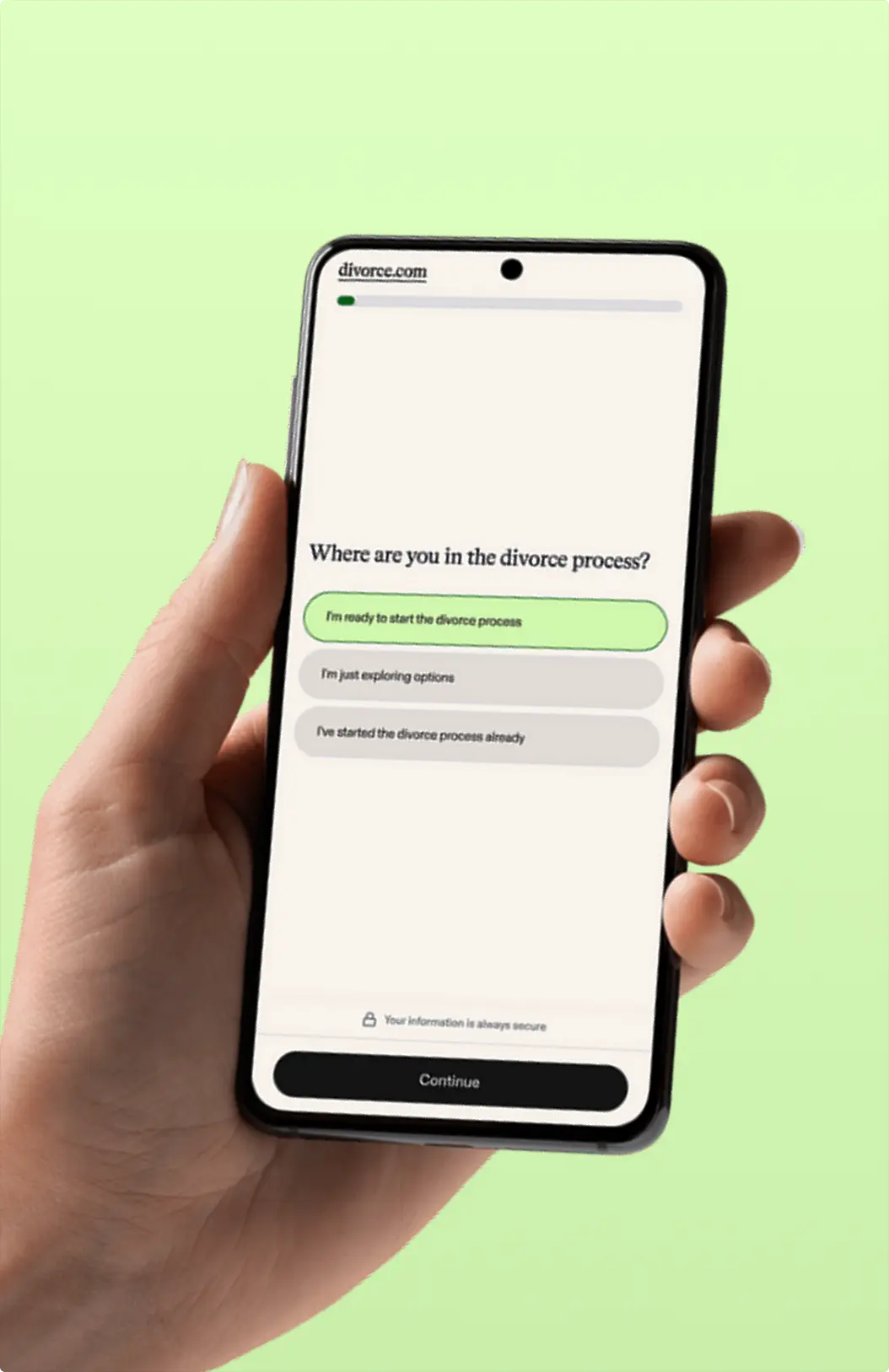
Let’s get your divorce started today.

Let’s get your divorce started today.

Complete your divorce forms online

We can help you complete and file the right paperwork online.

Start your divorce papers

Ready for your next step?

Get Started